About

Profile

I am Evangelia (Eva) Deliporanidou, a PhD candidate in Astrophysics at the University of Cambridge. My work focuses on modelling solar and stellar irradiance with statistical methods, machine learning, and physically informed models.

I enjoy connecting scientific rigor with computational efficiency, especially when building models that are interpretable, uncertainty-aware, and predictive under complex conditions.

I am also highly interested in quantitative finance, especially where statistical learning, risk modelling, and decision-making under uncertainty intersect with real-world markets.

Education

University of Cambridge · PhD in Astrophysics (Oct 2023 - Present)

  • Supervised by Prof. Giulio Del Zanna in the Astrophysics Group, Department of Applied Mathematics and Theoretical Physics (DAMTP). Funded by an STFC (UKRI) Doctoral Studentship.
  • PhD research focuses on developing physically motivated models of solar and stellar EUV irradiances by combining differential emission measure modelling, atomic physics, and proxies of activity. The resulting models enable reconstruction of stellar spectra for stars where direct EUV observations are unavailable.
  • Research collaborations with the University of Cambridge, NASA Goddard Space Flight Centre, NASA's Laboratory for Atmospheric and Space Physics (LASP), the international CHIANTI collaboration, and the ESA F-class mission SIRIUS, contributing to development and validation of stellar XUV irradiance models.
  • Contributed to the ongoing development of the CHIANTI atomic database (CHIANTI website), an internationally recognised collaboration honoured with the 2024 NASA Group Achievement Award for contributions to astrophysics. CHIANTI is widely used in solar physics to analyse spectroscopic observations (over 5,200 citations).
  • Extensive scientific programming in Python, IDL, and Fortran for spectral synthesis, plasma diagnostics, and astrophysical modelling.
  • Expected thesis submission: March 2027.

University College London · MSc in Astrophysics (Sept 2022 - Sept 2023)

Department of Physics and Astronomy PGT SSCC (Postgraduate Academic Representative / Student Staff Consultative Committees).

Modules: Galaxies Dynamics, Formation and Evolution; Physics of Stars; Mathematics for General Relativity; Cosmology; Advanced Physics Cosmology; Solar Physics; Climate and Energy; Research Essay (15,000 words); Research Project (40,000 words).

Research Project Topic: Towards a 3D Map of the Dust in the Nuclear Stellar Disk of the Milky Way. Combined infrared observations and statistical modelling to reconstruct the three-dimensional dust distribution within the Galactic Centre, improving our understanding of the Milky Way’s central structure. Supervised by Dr JasonSanders.

University of Strathclyde · BSc (1st Class Hons) Physics (Sept 2019 - Sept 2022)

  • Deferred entry into second year.
  • Second year average grade: 82%.
  • Third year average grade: 77%.
  • Fourth year average grade: 80%.
  • Graduated with distinction.

Modules: Quantum Mechanics and Electromagnetism (70%); Theoretical Physics (79%); Computational Physics (89%); Experimental Physics (88%); Astronomy (77%); Mathematical Physics (70%); Mechanics and Waves (70%); Gases, Liquids and Thermodynamics (78%); Communicating Physics (75%); Condensed Matter Physics (76%); Nanoscience (82%); Atomic, Molecular and Nuclear Physics (76%); Topics in Physics (Astrophysics and Plasma Physics, 78%).

Final Year Project: Atomic Processes for Astrophysical Plasmas (79%) - Quadrupole l-changing collisions. Supervised by Prof. Nigel Badnell. Investigated quantum mechanical atomic collision processes governing hydrogen- and helium-like ions, improving theoretical models of astrophysical plasma emission.

Additional Education (Online Courses & Workshops)

Machine Learning, DeepLearning.AI – Stanford (via Coursera)

  • Supervised ML: Regression & Classification.
  • Advanced Learning Algorithms.
  • Unsupervised Learning, Recommenders, and Reinforcement Learning.

Data Analysis Workshop, Imperial College London

  • Learning Bayesian methods and numerical techniques for astrophysical data analysis.
  • Applying data-analysis approaches to large datasets, improving model selection and parameter estimation.

CS50's Introduction to Cybersecurity, Harvard (online)

  • Learning core cybersecurity principles: threat identification, risk assessment, and mitigation.
  • Gaining hands-on skills in account security, multi-factor authentication, and social-engineering awareness.

Memberships-Fellowships

Fellow of the Royal Astronomical Society (RAS).

Member of the Cambridge University Algorithmic Trading Society.

Member of the Cambridge University Astronomical Society.
Research Funding and Awards

Awards & Funding

  • STFC Doctoral Studentship (UK Research and Innovation) – University of Cambridge
    Modelling the emission of the outer solar atmosphere

Conference Travel Awards

  • NASA Exoplanet Exploration Program Travel Award – Cool Stars 22, San Diego, USA
  • Royal Astronomical Society Travel Grant – UKSP25, Sheffield, UK (2025)

Sports Activities & Achievements

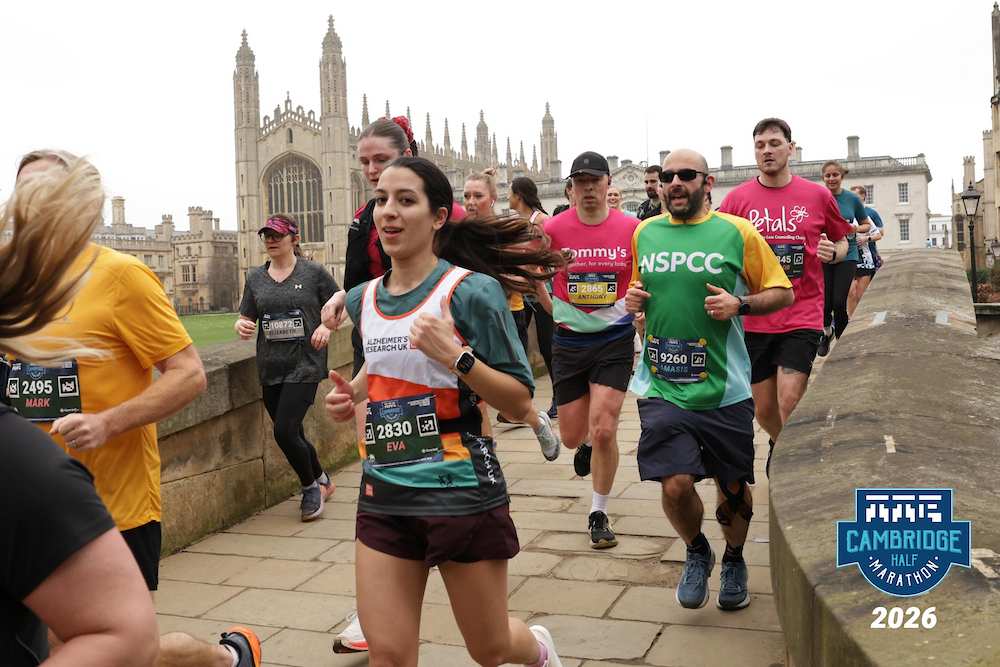
Evangelia Deliporanidou running the Cambridge Half Marathon

Cambridge Half Marathon 2026

Fundraised approximately £700 for Alzheimer’s Research UK through participation in the Cambridge Half Marathon 2026.

View my fundraising page